DEF Products
Our Diesel Exhaust Fluid Sales Team Helps You!

What is DEF? Diesel Exhaust Fluid, or DEF, is used in a Selective Catalytic Reduction System (SCR) and reduces Nitrogen
Oxide (NOx) emissions.
It brings 3 direct benefits to your trucks:
- They can’t run without it. Vehicles equipped with an SCR system use sensors to determine that DEF is in the system and not another liquid such as water. The SCR system is made integral to driving – when the DEF runs out the truck will slow to a crawl, and in deluxe models, it quits on you.
- DEF improves your fuel economy. By reducing exhaust gas re-circulation with a mix of water and urea DEF captures 90 percent of the foul air that would otherwise be injected back into your truck’s intake.
- Advertising that you’re a green brand increases your sales. It’s proven that telling people you have DEF as a part of your SCR system gives you a green, money-making benefit.
Call McPherson and ask for DEF: 1-888-802-7500
or email: customercare@mcphersonoil.com
We ship across the south – from Alabama to the Florida Panhandle.
DEF Jam
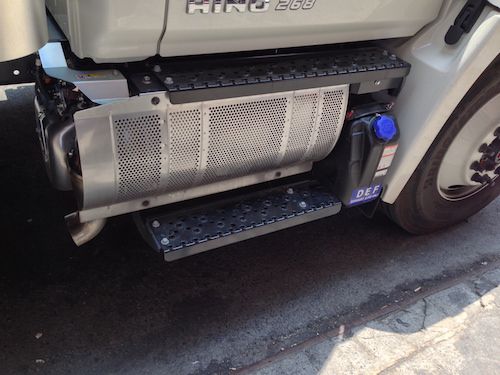
We know what DEF means for you.
In vehicles with an SCR system, you’ve got to treat DEF like your gasoline. Manufacturers help you by installing a DEF gauge, or low DEF warning light in your dashboard.
If your DEF depleted truck is still running your vehicle enters “Limp Mode” and throttles down to about 5 miles an hour, maximum – forcing you to drive it to the nearest DEF seller and top off the SCR to reinstate full diesel combustion.
You can find DEF at many C-stores, but why wait until you’ve got a limping, broken down truck? A busy business can’t afford that.
…Now’s the time to plan smart:
- Buy DEF from McPherson at a cheaper rate than you can at even your favorite retailers. The more you plan…the more you save.
- Equip your entire fleet with extra DEF and you’ll never be stranded limping down a lonely highway at 5 miles an hour…30 miles from the nearest exit to nowhere.
Call McPherson to talk to our DEF sales team at 1-888-802-7500, or at email us at customercare@mcphersonoil.com
Learn how we can streamline your fleet, save you money and lower your insurance exposure with a master plan for your Diesel Exhaust Fluid and SCR systems.
The Story of Diesel Exhaust Fluid

In 2010, cars and trucks with diesel engines that were sold in the United States had to meet new American EPA emissions requirements.
The 2010 Emissions standards in North America have mandated that all on-road diesel vehicles manufactured in 2010 or later must be equipped with technology to reduce NOx emissions. NOx emissions need to be removed from the air because they contribute to global warming, acid rain, and atmospheric particles that cause visual impairment.
To do so, many diesel engine manufacturers (OEM’s) decided to use Selective Catalytic Reduction (SCR), which is emissions after-treatment technology that converts nitrogen oxides (NOx) in the diesel-engine exhaust stream into nitrogen and water vapor…two natural components in the air we breathe.
It does this with the help of urea. Commonly known as a major component in mammal urine, it was the first organic chemical to be artificially produced in a lab. It’s a neutral solid that doesn’t have color or odor and dissolves in water. It’s also used in fertilizer.
SCR technology isn’t new—its been in use for many years in Europe and since the late 1950’s on large commercial boilers.
SCR converts NOx to nitrogen and water vapor using a catalyst, exhaust heat, and Diesel Exhaust Fluid (DEF). The DEF is injected into the diesel exhaust stream where it reacts with a chemical catalyst to convert NOx into a harmless gas.
- DEF is API certified and meets ISO22241 specifications.
- Diesel Exhaust Fluid is non-toxic, non-flammable, colorless, non-hazardous, and very easy to use, and applies to vehicles produced since 2010.
Currently, there are two technologies that meet these 2010 EPA guidelines: 1. Advanced EGR
and 2. Selective Catalytic Reduction (SCR)
SCR is the most widely used technology and can reduce NOx emissions by 70-90 percent.
Diesel Exhaust Fluid FAQ
Why is Diesel Exhaust Fluid needed?
The EPA has mandated that all Class 8 on-road diesel vehicles manufactured in 2010 must be equipped with systems to reduce NOx emissions.
What is Diesel Exhaust Fluid?
32.5% high purity automotive grade urea and 67.5% water.
Can I mix this fluid myself?
No, the process in which this fluid is mixed is very specific, the on-board system knows if the fluid is out of specification or if there is contamination. Concentrate urea is not available.
Do I change this fluid out, and how much do I need?
Since this fluid is consumed at a rate of 2% of diesel fuel usage, this fluid is re-filled rather than replaced with other engine products such as antifreeze and engine oil. Tanks on board vary in size from 16-50 gallons in larger trucks. The tank must have fluid in it to operate.
How will a driver know when they are low on Diesel Exhaust Fluid?
There are simple warning indicators right on the dashboard for the drivers indicating the level of the fluid.
Where do I get Diesel Exhaust Fluid?
Diesel Exhaust Fluid is available in Alabama, Georgia, Tennessee, and the Florida Panhandle through our distribution network. To place an order, contact Customer Service at 1-888-802-7500 or email us at customercare@mcphersonoil.com.
What happens if Diesel Exhaust Fluid gets too hot or too cold?
When DEF gets too cold there is no harm whatsoever to the shelf life of the fluid, however, it begins to freeze at 12ºF. Trucks will start and the tank will be heated until the solution starts to flow and the driver is on his way. Storage for long periods at high temperatures can reduce the shelf life of the fluid.
Can diesel fuel be pumped into the DEF tank?
Diesel is similar to DEF, so people trying to get around using DEF my consider pumping in straight diesel.
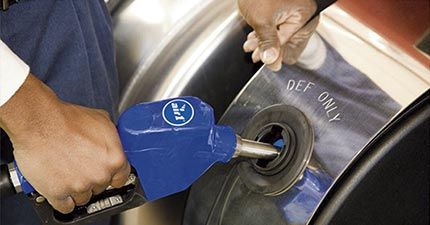
To avoid this, the industry standard for on-board DEF dispensing holes is smaller than that of diesel tanks. The nozzles at fuel islands for diesel fuel will not fit the onboard DEF tank.
Ask how SCR systems can lower your fleet spending at 1-888-802-7500
or email: customercare@mcphersonoil.com